

12 B2B Lead Generation Best Practices to Boost Pipeline
Most B2B sales teams don't have a lead problem, they have a process problem. Leads come in from multiple sources, follow-up is inconsistent, and promising prospects slip through the cracks before anyone picks up the phone. Knowing the right b2b lead generation best practices isn't just about filling your pipeline; it's about building a system that actually converts.
We built LeadMailbox to solve exactly this. Since 2004, we've helped sales teams aggregate leads, automate outreach, and close deals faster, all from one platform. That experience has given us a front-row seat to what separates teams that grow from teams that stall. The difference almost always comes down to execution.
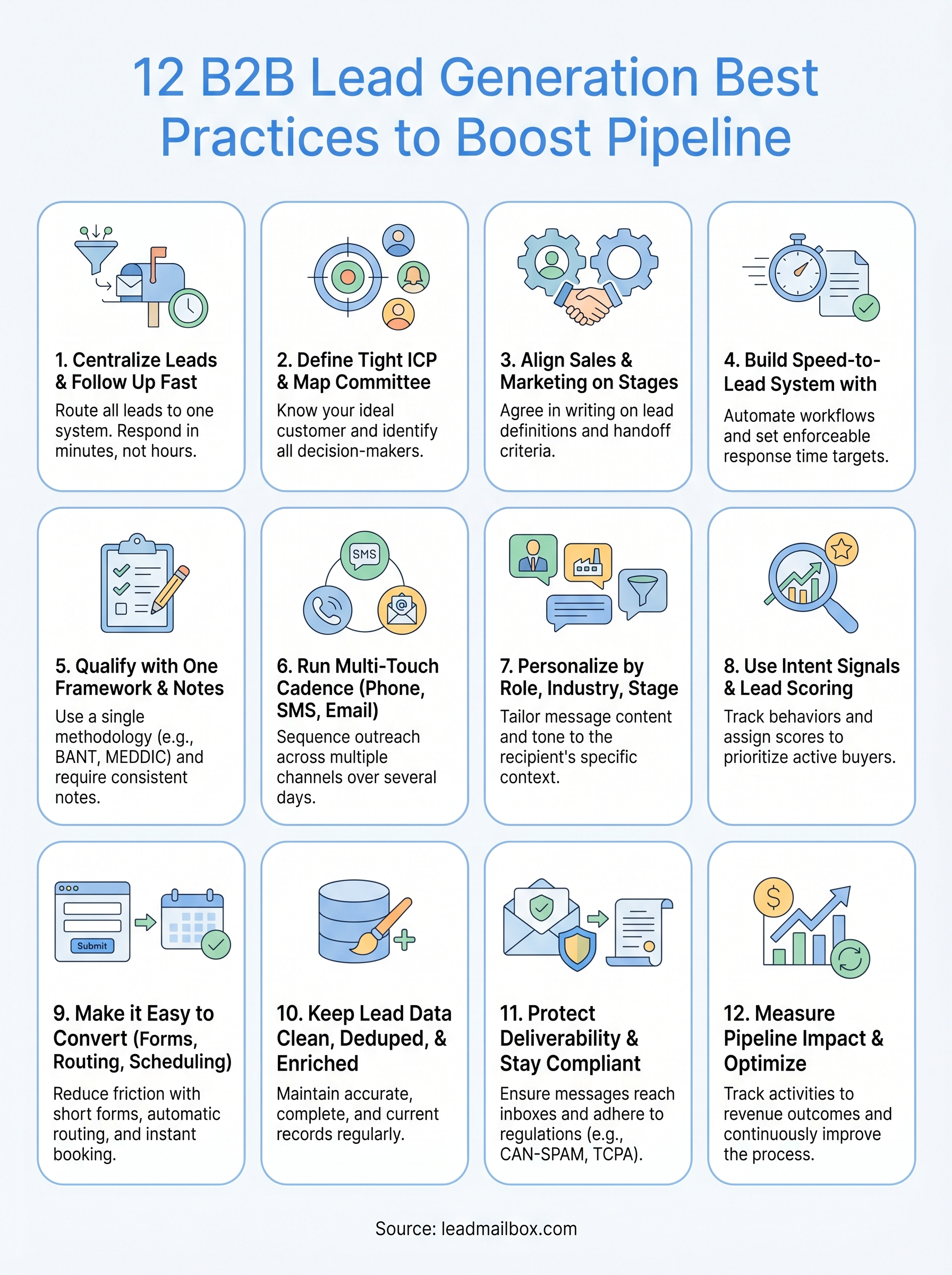
This article breaks down 12 proven practices to sharpen your B2B lead generation from start to finish. Whether you're refining an existing process or building one from scratch, these are the strategies that move the needle.
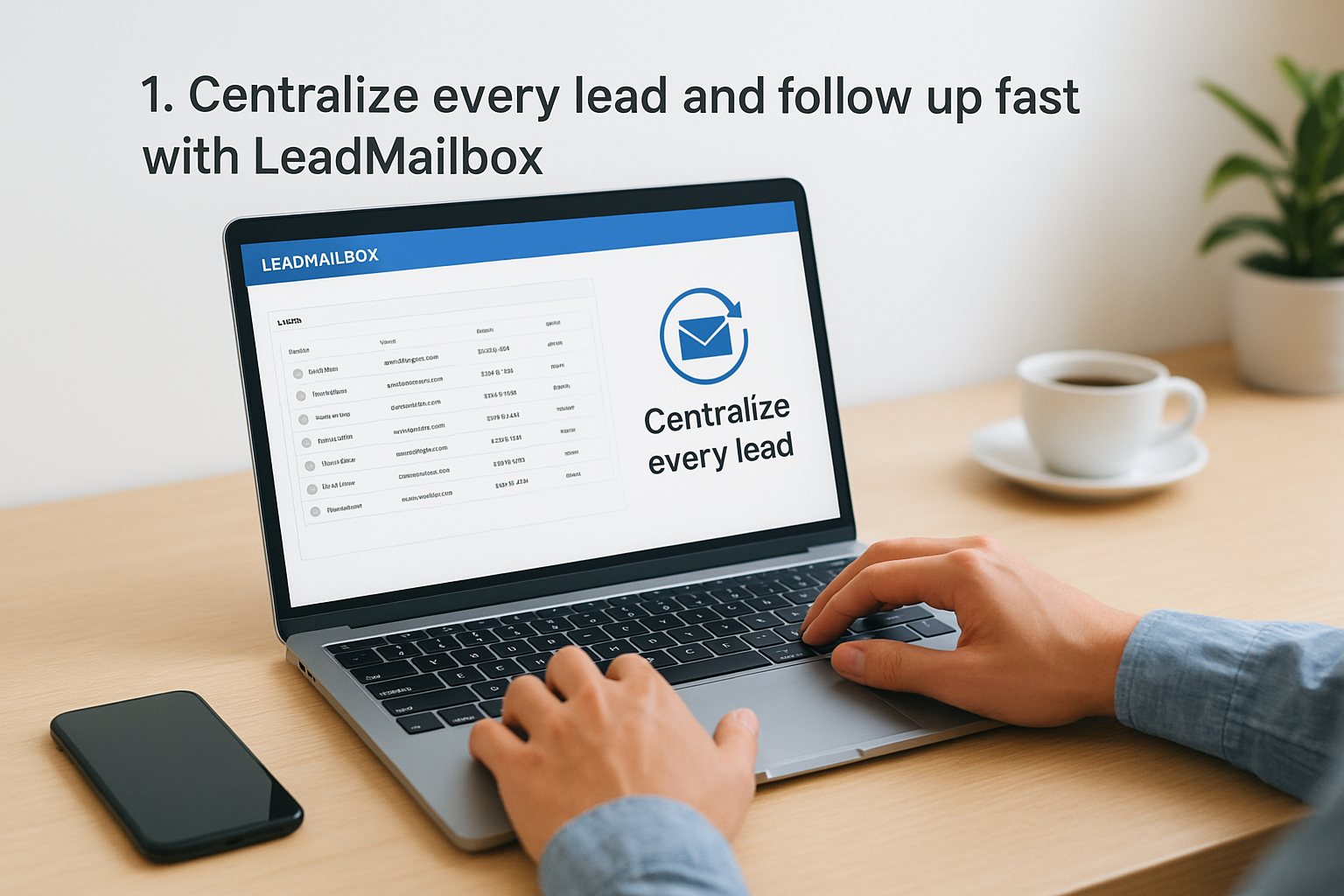
1. Centralize every lead and follow up fast with LeadMailbox
When leads come from paid ads, referrals, web forms, and third-party partners, they scatter across spreadsheets, inboxes, and disconnected platforms. That fragmentation kills response time. One of the core b2b lead generation best practices is making sure every lead lands in one place and gets a response before a competitor beats you to it.
What it is
Centralizing leads means routing every inbound contact into a single lead management system regardless of source. Fast follow-up means contacting that lead within minutes, not hours. Research from Harvard Business Review shows that companies responding to leads within an hour are seven times more likely to qualify them than those that wait even 60 more minutes.
The window to connect with a new B2B lead is shorter than most teams assume, and every minute of delay cuts your odds of making contact.
How to do it
Start by listing every source that currently sends you leads. Then connect each source to a central platform so new leads appear automatically without manual imports. LeadMailbox integrates with hundreds of lead partners, pulling contacts directly into your pipeline the moment they submit.
Once leads are centralized, set up an automated first-touch sequence. Use click-to-call or a power dialer to reach out within five minutes of a lead arriving. Pair that with an automatic SMS so the prospect hears from you on two channels before your competition even opens their inbox.
Metrics to track
Tracking the right numbers tells you whether your centralization and follow-up system is actually working. Monitor these key performance indicators consistently:
- Lead response time: Average minutes between submission and first contact attempt
- Contact rate: Percentage of leads that answer or respond to the first outreach
- Source coverage: Percentage of lead sources connected to your central system
- First-touch conversion rate: Percentage of contacted leads that advance to qualified status
Common mistakes
The most common mistake is treating centralization as a one-time setup. New lead sources get added over time and often get missed, which means they route to someone's personal inbox and fall through the cracks. Audit your lead routing quarterly to confirm every source still connects to your central system and that response time targets are being met across all of them.
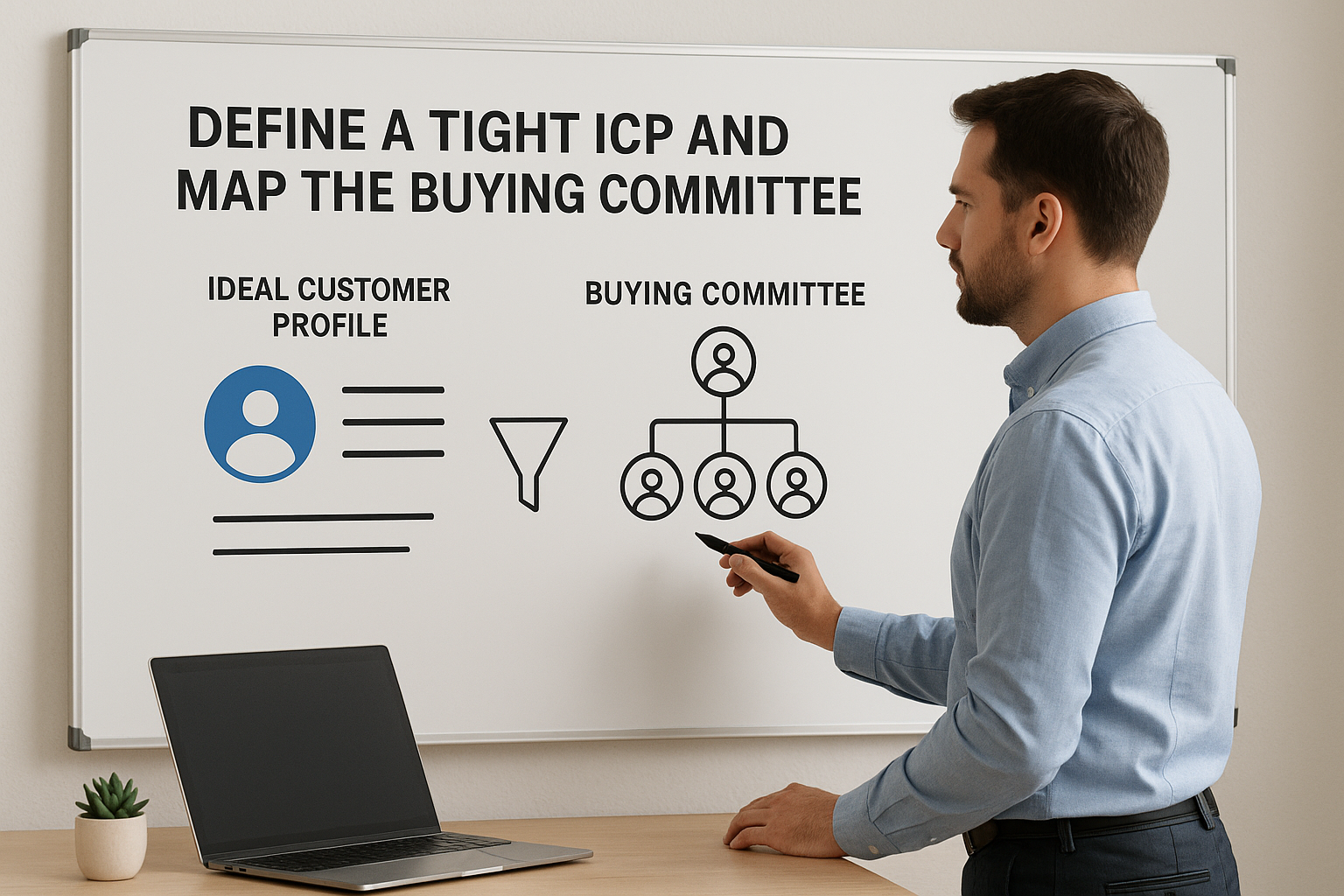
2. Define a tight ICP and map the buying committee
One of the most overlooked b2b lead generation best practices is knowing exactly who you're targeting before you spend a dollar on outreach. Without a clear Ideal Customer Profile (ICP), your team wastes time chasing leads that will never close.
What it is
Your ICP is a detailed description of the company type most likely to buy, stay, and refer others. Mapping the buying committee goes one step further by identifying every person involved in the purchase decision, from the end user to the budget holder.
In B2B, you rarely sell to one person. Ignoring the full committee means losing deals to internal stakeholders you never reached.
How to do it
Start by pulling data from your last 20 closed-won deals. Look for shared firmographic traits like company size, industry, revenue range, and tech stack. Then identify the job titles and roles that appeared consistently across those deals. Use that pattern to build your ICP and a committee map with a champion, an economic buyer, and a technical gatekeeper for each account type.
Metrics to track
Track these numbers to confirm your ICP is accurate and your committee coverage is working:
- ICP match rate: Percentage of new leads that fit your defined profile
- Multi-contact rate: Percentage of target accounts where you've reached more than one stakeholder
Common mistakes
Most teams define an ICP once and never revisit it. As your product evolves and market conditions shift, your best-fit customer changes too. Review your ICP every quarter using closed-won and closed-lost data to keep it accurate.
3. Align sales and marketing on lead stages and handoffs
When marketing and sales use different definitions for the same terms, leads get stuck in the handoff. Marketing thinks a lead is ready to talk; sales thinks it still needs nurturing. That gap is one of the most common execution failures in b2b lead generation best practices, and it quietly kills conversion rates.
What it is
Alignment means both teams agree in writing on what each lead stage looks like and what triggers a handoff from marketing to sales. A Marketing Qualified Lead (MQL) should meet specific criteria that sales has already approved, not just whatever the marketing team decides fits.
A handoff without a shared definition is just one team dumping work on another.
How to do it
Start by running a joint session with both teams to define each stage: subscriber, MQL, Sales Qualified Lead (SQL), and opportunity. Document the exact criteria for each, including firmographic fit, engagement signals, and minimum information required. Then build that definition into your lead management system so leads only advance when the criteria are met, not when someone manually moves them.
Metrics to track
These numbers tell you whether your alignment is actually holding up over time:
- MQL-to-SQL conversion rate: The percentage of marketing-passed leads that sales accepts
- Rejection rate: How often sales sends leads back to marketing as unqualified
- Handoff time: Average hours between MQL status and first sales contact
Common mistakes
Teams often skip the formal written agreement and rely on informal understanding instead. When team members change or workloads increase, that informal understanding breaks down fast. Document your stage definitions, review them quarterly, and make sure every new hire on both teams reads them before touching a lead.
4. Build a speed-to-lead system with clear SLAs
Speed-to-lead isn't just a nice metric to track; it's one of the most direct levers you have over pipeline conversion. Among all b2b lead generation best practices, few have as immediate an impact as reaching a prospect before they've moved on to someone else. A Service Level Agreement (SLA) takes that urgency and turns it into an enforceable team standard.
What it is
A speed-to-lead system is a defined workflow that guarantees every new lead receives a contact attempt within a set window, typically five minutes or less. An SLA is the written commitment that holds your team accountable to that window. Without both in place, fast follow-up happens only when someone remembers to do it.
Research consistently shows that lead contact rates drop sharply after the first five minutes, making response speed one of the highest-leverage variables in your entire sales process.
How to do it
Map out every step between lead submission and first contact, then eliminate manual handoffs wherever possible. Use automated assignment rules to route leads to the right rep instantly. Set your SLA target in writing, communicate it to the full team, and configure alerts or escalations that trigger when a lead sits untouched past the agreed window.
Metrics to track
Monitor these numbers weekly to confirm your SLA is holding:
- Average response time: Minutes between lead submission and first contact attempt
- SLA compliance rate: Percentage of leads contacted within your defined window
Common mistakes
The most common mistake is setting an SLA without building any enforcement mechanism behind it. If reps face no consequence for missing the window and no alert fires when a lead ages out, the SLA becomes a document no one reads. Tie compliance to your weekly pipeline reviews so it stays visible.
5. Qualify leads with one framework and consistent notes
When reps each qualify leads using their own criteria, your pipeline data becomes noise. One of the most practical b2b lead generation best practices is picking a single qualification framework and requiring consistent notes so every lead gets evaluated the same way.
What it is
A qualification framework is a structured set of criteria for deciding whether a lead is worth pursuing. You pick one methodology and apply it team-wide without exceptions.
Common options include BANT (Budget, Authority, Need, Timeline) and MEDDIC (Metrics, Economic Buyer, Decision Criteria, Decision Process, Identify Pain, Champion). Choose the one that fits your deal complexity and document it clearly before rolling it out.
Inconsistent qualification produces pipeline data you can't trust when it's time to forecast.
How to do it
Pick your framework, then document the exact questions each rep should ask for every criterion. Build those questions into your lead management system as required fields so a lead cannot advance without complete answers.
- Define what a passing answer looks like for each criterion
- Require notes in a standardized format before a lead status can change
Metrics to track
Track these key numbers to confirm your qualification process is working:
- SQL-to-opportunity rate: Percentage of qualified leads that move to active deals
- Forecast accuracy: How closely your pipeline predictions match actual closed revenue
Common mistakes
Most teams select a framework and then skip enforcement. Without required fields in your system, reps fill in whatever they feel like, and the structure collapses within weeks.
Tie qualification completeness to your weekly pipeline reviews so gaps get caught early before they skew your forecast.
6. Run a multi-touch cadence across phone, SMS, and email
Reaching a B2B prospect once and waiting rarely works. Among b2b lead generation best practices, running a structured multi-touch cadence across multiple channels is one of the most reliable ways to increase contact rates and keep your pipeline moving.
What it is
A multi-touch cadence is a planned sequence of outreach attempts spread across phone, SMS, and email over a defined number of days. Each channel serves a different purpose: calls create personal connection, SMS gets read fast, and email lets you share more detail. Using all three together multiplies your chances of getting a response.
Relying on a single channel gives a prospect one easy way to ignore you. A coordinated cadence makes it harder to slip through the cracks.
How to do it
Build a sequence that spans at least 8 to 10 touches over 10 to 14 days. Start with a call on day one, follow with an SMS on day two, and send a short personalized email on day three. Repeat the pattern with varied messaging at each step so you're not sending the same note twice. LeadMailbox lets you automate this entire sequence from one place, so reps spend time talking, not scheduling.
Metrics to track
Watch these numbers to evaluate cadence performance:
- Cadence response rate: Percentage of leads that reply or answer at any point in the sequence
- Channel response breakdown: Which channel generates the most replies
Common mistakes
Most teams front-load all their effort into the first two touches and quit too early. If a prospect hasn't responded by day three, that doesn't mean they're not interested. Stick to your full sequence before marking a lead as unresponsive.
7. Personalize outreach by role, industry, and funnel stage
Generic outreach gets ignored. When a VP of Sales receives the same message as an IT Director, both delete it because neither speaks to their actual problem. Among all b2b lead generation best practices, personalizing your outreach by role, industry, and funnel stage is what turns a cold message into a real conversation.
What it is
Personalization means tailoring your message content and tone to match what a specific recipient actually cares about. A budget-focused CFO needs different framing than a workflow-focused operations manager, and a prospect who just downloaded a guide needs different messaging than one who already attended a demo.
Generic outreach signals that you haven't done the work to understand the person you're contacting.
How to do it
Start by building message templates for each primary role in your buying committee: one for economic buyers, one for end users, and one for technical gatekeepers. Then create funnel-stage variations for each template so your early-stage message introduces a problem while your late-stage message reinforces proof with specifics.
Layer in industry-specific details like relevant pain points or common workflows so each message feels written for that exact person. LeadMailbox lets you store these templates and apply them based on role and stage fields already in your pipeline.
Metrics to track
Watch these numbers to evaluate whether your personalization is actually working:
- Reply rate by role: Which titles respond most often to your outreach
- Open-to-reply rate by stage: Whether funnel-stage messaging moves prospects forward
Common mistakes
Most teams add a first-name token and consider their outreach personalized. That approach fails because prospects notice immediately when only the name changed and nothing else reflects their context. Write distinct messages for each role and stage combination before you scale.
8. Use intent signals and lead scoring to focus on buyers
Not every lead in your pipeline deserves equal attention right now. Among b2b lead generation best practices, using intent signals and lead scoring to identify the most active buyers is one of the fastest ways to improve the efficiency of your entire sales team.

What it is
Intent signals are behaviors that indicate a prospect is actively researching a problem you solve, things like visiting your pricing page multiple times, downloading a case study, or opening three emails in one week. Lead scoring assigns point values to those behaviors so you end up with a ranked list of leads based on their actual level of engagement and fit.
Chasing low-intent leads at the same rate as high-intent ones spreads your team thin and slows down the deals most likely to close.
How to do it
Start by listing the five to ten behaviors that historically appear before a lead converts. Assign higher scores to high-intent actions like demo requests and lower scores to early-stage actions like a single page visit. Build your scoring model into your lead management system so the ranking updates automatically as prospects engage, not when someone remembers to update a spreadsheet.
Metrics to track
Watch these numbers to confirm your scoring model is doing its job:
- Score-to-close correlation: Whether higher-scored leads actually close at a higher rate
- Coverage rate: Percentage of high-score leads contacted within your SLA window
Common mistakes
Most teams set their scoring model once and never adjust it. As your product and buyer behavior change, scores that worked last year can mislead your reps this year. Revisit your model every quarter using recent closed-won data to keep the rankings accurate.
9. Make it easy to convert with forms, routing, and scheduling
Even strong intent signals fail to produce pipeline when the conversion path is frustrating. Among all b2b lead generation best practices, reducing friction at the exact moment a prospect decides to engage is one of the most underutilized levers available to you.
What it is
Conversion friction is anything that slows down or discourages a prospect from taking the next step, whether that's a form with 12 fields, a routing delay that sends them to the wrong rep, or a scheduling tool that requires three back-and-forth emails to book a call. Removing that friction means fewer drop-offs between interest and contact.
The moment a prospect decides to reach out is your highest-leverage window; a clunky process wastes it entirely.
How to do it
Keep your web forms short: ask only for the information you need to route and qualify the lead, nothing more. Build automatic routing rules based on territory, company size, or product interest so leads reach the right rep without a manual review step. Add a scheduling link directly in your confirmation page so a prospect can book time immediately after submitting a form.
Metrics to track
- Form completion rate: Percentage of visitors who start and finish your form
- Routing accuracy: Percentage of leads assigned to the correct rep on first assignment
Common mistakes
Most teams add form fields over time without removing old ones, and the form slowly becomes a barrier. Audit your forms quarterly and remove any field that your team cannot act on immediately after receiving it.
10. Keep lead data clean, deduped, and enriched
Bad data is a silent pipeline killer. Among all b2b lead generation best practices, maintaining clean, deduplicated, and enriched records is the one most teams ignore until the damage is already done. Duplicate records split your contact history, enrichment gaps leave reps without context, and stale information sends your outreach to people who changed roles six months ago.
What it is
Clean data means every record has accurate, complete, and current information. Deduplication removes or merges duplicate entries so one prospect doesn't have three separate records with different activity histories. Enrichment adds missing firmographic and contact details automatically so reps don't have to research each lead before making a call.
Dirty data doesn't just waste your team's time; it produces pipeline forecasts you cannot trust.
How to do it
Run a deduplication pass on your database at least once per month. Set validation rules on your intake forms to catch formatting errors like inconsistent phone formats or missing company names before records even enter your system. Use enrichment tools to automatically fill gaps in job title, company size, and industry based on email domain or LinkedIn data so reps always have enough context to personalize their first call.
Metrics to track
- Duplicate rate: Percentage of records with a matching entry in the same database
- Data completeness score: Percentage of records with all required fields filled
Common mistakes
Most teams run a one-time cleanup after noticing problems and then do nothing until the data degrades again. Build a recurring maintenance schedule into your operations calendar so data quality stays consistent rather than cycling between clean and broken.
11. Protect deliverability and stay compliant
Your outreach only works if it actually reaches people. Among all b2b lead generation best practices, protecting your email and SMS deliverability while staying compliant with regulations is the one most teams treat as an afterthought until they hit a wall.
What it is
Deliverability refers to your ability to land messages in a prospect's inbox or SMS thread rather than a spam folder or blocked queue. Compliance means operating within legal frameworks like CAN-SPAM for email and TCPA for phone and SMS outreach in the United States. Ignoring either one puts your entire outreach program at risk.
A single spam complaint spike or compliance violation can damage your sender reputation in ways that take months to reverse.
How to do it
Authenticate your email domain using SPF, DKIM, and DMARC records so receiving servers can verify your identity. Keep your contact lists current by removing bounced addresses and unsubscribes immediately after each campaign. For SMS and phone outreach, confirm every contact has given explicit consent before you dial or text, and maintain a record of that consent in case you ever need to produce it.
Metrics to track
Watch these numbers on a weekly basis to catch problems before they compound:
- Bounce rate: Percentage of emails that fail to deliver
- Spam complaint rate: Percentage of recipients who mark your messages as spam
Common mistakes
Most teams treat compliance as a legal formality rather than an operational habit. Building consent verification and list hygiene into your weekly workflow is far less painful than recovering from a damaged sender reputation or a regulatory fine.
12. Measure pipeline impact and keep optimizing
All the b2b lead generation best practices in this article only produce results if you measure what they're doing to your pipeline and act on what you find. Without consistent measurement, you're guessing at which changes are working and which ones are quietly costing you deals.
What it is
Pipeline measurement means tracking lead generation activities back to their actual revenue impact, not just volume metrics like leads generated or calls made. The goal is to connect every upstream action to downstream outcomes like opportunities created, deals closed, and revenue won so you can make decisions based on real data.
Tracking activity without tying it to pipeline outcomes tells you how busy your team is, not how effective they are.
How to do it
Start by identifying the three to five metrics that link directly to closed revenue for your business. Build a weekly reporting habit where you review those numbers as a team and flag any stage where conversion has dropped. When you spot a drop, isolate the variable by looking at what changed in that period, whether it was a new rep, a different message, or a shift in lead source quality.
Metrics to track
Prioritize these numbers to get a clear view of pipeline health:
- Lead-to-opportunity rate: Percentage of leads that reach active deal status
- Pipeline velocity: Average days from first contact to closed deal
- Revenue by lead source: Which sources produce the highest close rates
Common mistakes
Most teams measure activity volume and stop there. Calls made and emails sent are inputs, not outcomes. Shift your reviews toward conversion rates at each stage so your team optimizes for results rather than effort.
Next steps
These 12 b2b lead generation best practices give you a clear path from scattered leads and inconsistent follow-up to a pipeline that actually produces revenue. The practices work together: clean data feeds accurate scoring, aligned teams honor SLAs, and multi-touch cadences reach prospects that single-channel outreach misses entirely.
Picking all 12 at once is overwhelming. Start with the two or three areas where your process breaks down most visibly, whether that's slow follow-up, unqualified leads clogging your pipeline, or outreach that never gets a reply. Fix those first, measure the results over a full quarter, then layer in the next set of improvements.
LeadMailbox gives you centralized lead management, built-in telephony, and automated multi-channel outreach in one platform so you can put these practices into action without stitching together a dozen separate tools. Start there and build a foundation that scales alongside your team as your pipeline grows.