

How To Convert Leads Into Sales: A Step-By-Step Playbook
You're generating leads. They're coming in from forms, ads, partner sources, maybe all of the above. But somewhere between that first contact and a closed deal, too many of them go cold. If you've been searching for how to convert leads into sales, you're probably feeling that gap between lead volume and actual revenue.
The problem usually isn't the leads themselves. It's what happens, or doesn't happen, after they arrive. Slow follow-ups, disorganized pipelines, and generic outreach kill deals before they ever get started. Most sales teams know this, but fixing it requires more than good intentions. It takes a repeatable system built around speed, personalization, and consistency.
That's exactly what this playbook breaks down. We've spent over 20 years at LeadMailbox helping sales teams aggregate, manage, and act on leads from hundreds of sources, using built-in calling, SMS, email, and AI tools to make sure no opportunity slips through. This guide pulls from that experience to give you a step-by-step process you can start using immediately, whether you're a solo operator or running a full sales floor.
What lead conversion is and what to measure
Lead conversion is the process of moving a prospect from initial interest to a paying customer. It sounds straightforward, but the gap between generating a lead and closing a deal involves multiple handoffs, touchpoints, and decisions that can break down at any stage. Understanding this process is the foundation for figuring out how to convert leads into sales in a way that's repeatable and measurable, not just occasional and lucky.
What lead conversion actually means
A lead becomes a conversion when that person takes a specific, defined action that moves them further down your sales funnel, which typically means paying for your product or service. Conversion isn't a single event, though. It's a sequence: a lead gets captured, qualified, contacted, nurtured, and eventually closed. Each step is its own mini-conversion, and each one has a measurable drop-off rate. Losing track of where prospects fall off is one of the most common reasons sales teams struggle to grow revenue despite having strong lead volume.
The goal isn't just to get leads in. It's to build a process that moves them forward at every stage.
Your definition of conversion will depend on your sales model. For a high-volume, low-ticket business, conversion might mean a completed online purchase. For a service-based or consultative business, it means a signed contract after a discovery call. Get clear on what conversion looks like for your specific business before you try to optimize for it, because measuring the wrong outcome will lead you in the wrong direction.
The metrics that tell you how well you're converting
Once you know what a conversion looks like, you need numbers to track how your pipeline is performing. Measuring the right metrics lets you identify where deals are stalling and which parts of your process need immediate attention. Here are the core conversion metrics worth tracking:
| Metric | What it measures | Why it matters |
|---|---|---|
| Lead-to-opportunity rate | % of leads that become qualified opportunities | Shows if your lead sources are sending the right people |
| Opportunity-to-close rate | % of qualified leads that become customers | Reflects how well your sales process works |
| Time to first contact | How fast your team reaches a new lead | Faster contact directly improves close rates |
| Follow-up attempts per lead | Average touches before a response | Shows if you're giving up too early |
| Cost per acquisition (CPA) | Total spend divided by new customers | Helps evaluate ROI across lead sources |
| Sales cycle length | Average days from first contact to close | Identifies bottlenecks and improves forecasting |
Tracking these numbers regularly gives you a factual picture of your pipeline instead of guesswork. A team that measures conversion at every stage can make targeted improvements, while a team that only looks at total closed deals has no clear idea which part of the process broke down when numbers drop.
Pull your last 90 days of data and fill in as many of these metrics as possible. Even rough numbers reveal patterns. Knowing your current baseline is the only way to confirm whether the changes you make are actually moving the needle.
Step 1. Capture, enrich, and route leads fast
Speed is the single biggest variable in lead conversion. Research shows that contacting a prospect within the first hour of their inquiry makes you far more likely to qualify that lead than waiting even a few hours longer. If your capture and routing process is slow or manual, you're already behind before your team makes a single call. Getting this step right sets the pace for everything that follows.
Pull every lead into one place
Scattered leads are lost leads. When inquiries arrive from multiple sources like ads, forms, partner feeds, and referrals and land in separate inboxes or spreadsheets, the time it takes to find and act on each one compounds quickly. Centralizing every lead into one platform automatically is the first concrete move in figuring out how to convert leads into sales at scale.
Run through this capture checklist for your current setup:
- Every lead source feeds into one central system automatically
- Duplicate leads are flagged or merged before reaching your team
- A timestamp is recorded on every record to track time-to-contact
- Lead source is tagged on each record for attribution tracking
Enrich before you reach out
A name and phone number alone gives your rep almost nothing to work with. Enriching a lead record with job title, company size, industry, or expressed interest before the first call means your rep can open with something relevant instead of starting cold.
The more context your rep has before first contact, the faster that first conversation moves toward a real next step.
Many lead management platforms pull enrichment data automatically when a new record is created. At minimum, require your intake forms to collect every field your team needs to have a productive opening conversation.
Route to the right rep immediately
Once a lead is captured and enriched, it needs to reach the right person without delay. Routing rules should be based on hard criteria, such as geography, lead source, product interest, or current rep capacity, not whoever happens to check the shared inbox first. Set those rules upfront so every lead gets assigned within minutes.
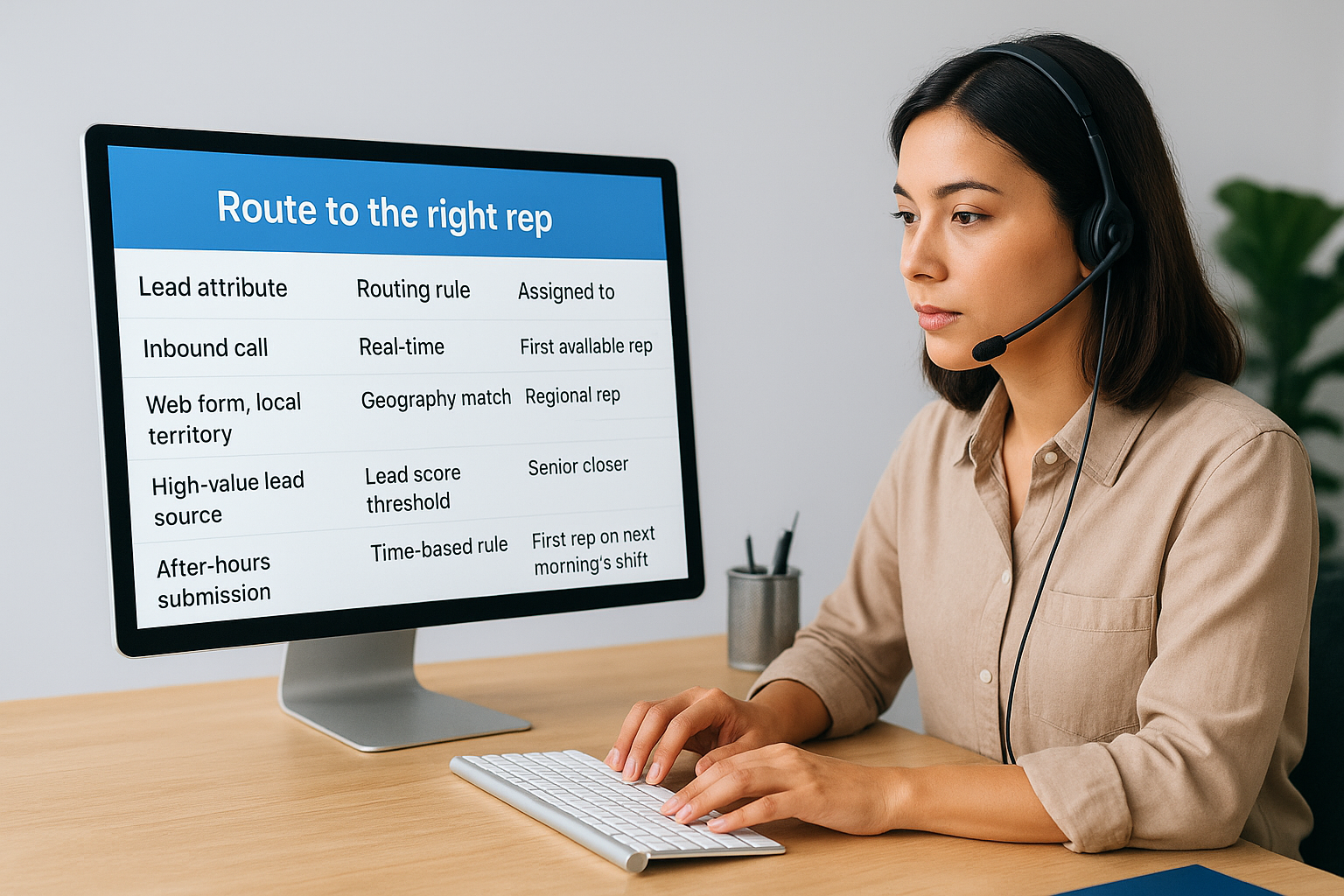
A basic routing logic table helps make this concrete:
| Lead attribute | Routing rule | Assigned to |
|---|---|---|
| Inbound call | Real-time | First available rep |
| Web form, local territory | Geography match | Regional rep |
| High-value lead source | Lead score threshold | Senior closer |
| After-hours submission | Time-based rule | First rep on next morning's shift |
Step 2. Qualify and prioritize the right leads
Not every lead deserves equal attention. Spending the same time on every contact in your pipeline treats a highly motivated buyer the same as someone who clicked an ad out of curiosity. Learning how to convert leads into sales more efficiently means making a deliberate call about which prospects are worth your team's time right now and which ones need a different approach.
Build a simple qualification framework
Qualification starts with a defined set of criteria your team applies consistently to every lead. Without a shared framework, one rep calls every contact twice and marks them qualified, while another runs six touches and still isn't sure. The most widely used model is BANT: Budget, Authority, Need, and Timeline. It gives you four concrete questions to answer before you move a lead forward in your pipeline.
Use this as a baseline qualification checklist:
- Budget: Does the prospect have the financial capacity to buy your product or service?
- Authority: Are you speaking with the person who can actually approve the purchase?
- Need: Does a clear, active problem exist that your solution directly addresses?
- Timeline: Is there a defined window in which they plan to make a decision?
Any lead that answers yes to all four moves forward as a qualified opportunity. Leads that fail on one or more criteria go into a nurture sequence rather than your active pipeline, so your reps stay focused on deals that can actually close.
Score leads to focus on the best ones first
Qualification tells you whether a lead is worth pursuing. Lead scoring tells you who to call first. Assign point values to specific lead attributes and behaviors so your reps always work the highest-potential contacts before anything else on their list.
The rep who calls the best lead first thing in the morning consistently outperforms the rep who starts with whoever is on top of an unsorted list.
A simple scoring model keeps this practical:
| Attribute or behavior | Points |
|---|---|
| Requested a demo or callback | +20 |
| Opened email within 24 hours | +10 |
| Matches your target industry | +10 |
| Has decision-making authority | +15 |
| Outside target geography | -10 |
| No response after 5 touches | -15 |
Build this scoring table into your lead management platform so reps see a ranked list every time they log in, not a flat stack of contacts with no priority signal attached.
Step 3. Run a follow-up system that gets replies
Most leads don't convert on the first contact. The average prospect needs between 5 and 8 touches before they respond, yet most sales reps quit after one or two attempts. If you're serious about figuring out how to convert leads into sales, building a structured follow-up sequence is non-negotiable. Without one, your team's effort stays inconsistent and most leads never hear from you again after the first missed call.
A follow-up system removes the guesswork from persistence and turns sporadic outreach into a predictable, repeatable process.
Set a multi-touch sequence before your team starts dialing
Define your follow-up cadence in advance so every rep runs the same playbook. Mixing channels like phone, SMS, and email across a defined number of days keeps your name in front of a prospect without feeling like harassment. Here's a proven 7-day starter sequence you can plug in immediately:
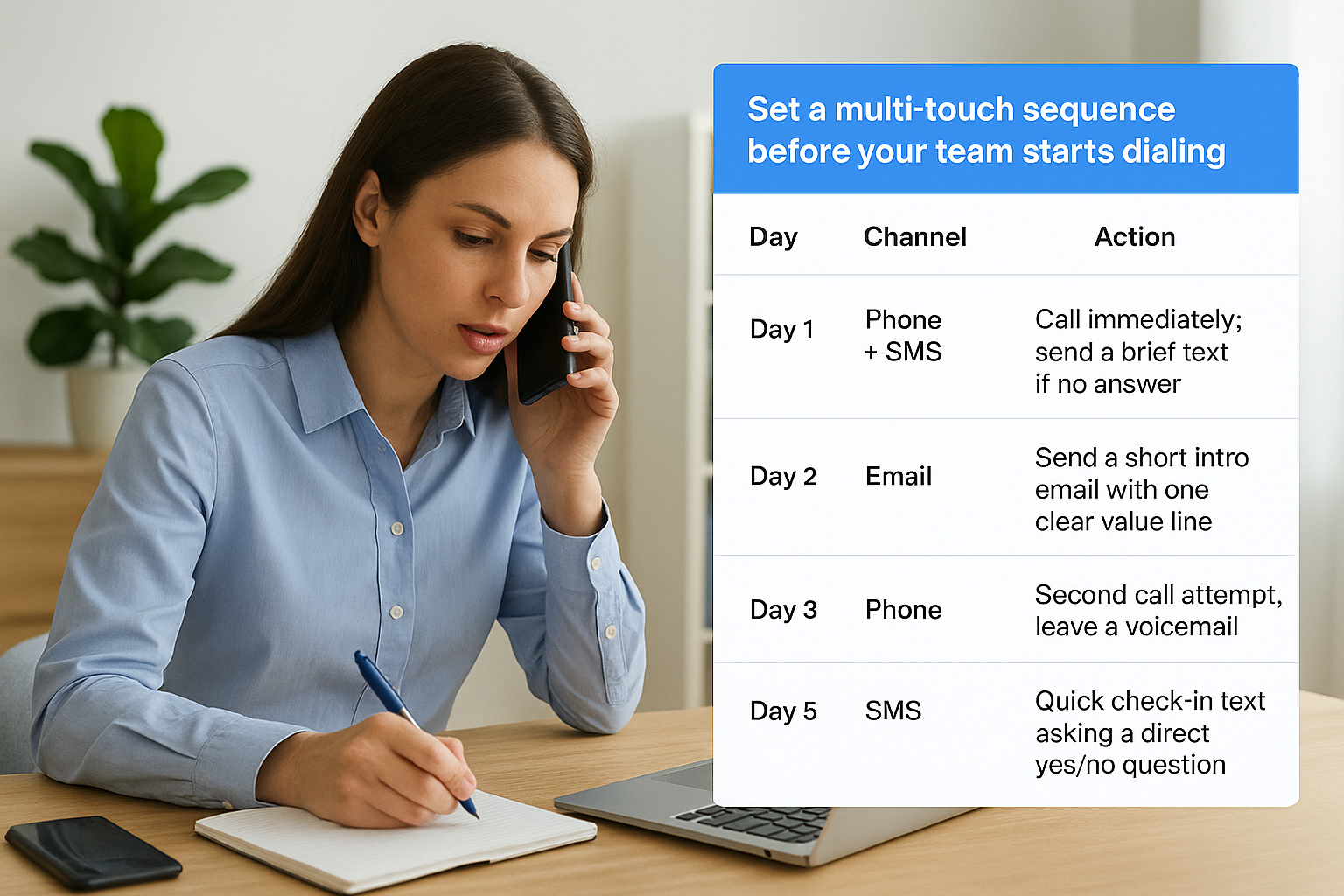
| Day | Channel | Action |
|---|---|---|
| Day 1 | Phone + SMS | Call immediately; send a brief text if no answer |
| Day 2 | Send a short intro email with one clear value line | |
| Day 3 | Phone | Second call attempt, leave a voicemail |
| Day 5 | SMS | Quick check-in text asking a direct yes/no question |
| Day 7 | Final follow-up with a low-friction next step |
Stick to this cadence for every new lead and adjust timing based on your response rate data once you have enough volume to draw conclusions.
Write messages that actually earn a reply
Short, direct messages outperform long, detailed ones in cold outreach. Each message should contain one specific reason for reaching out and one clear ask, nothing more. Skip the generic "just checking in" lines that give the prospect zero reason to respond.
Use this SMS template as a starting point:
Hi [First Name], this is [Your Name] from [Company].
You requested info on [topic].
Is [specific outcome] something you're still working toward?
Reply YES or call me back at [number].
Personalize the bracketed fields for every contact and test two versions of each message type to identify which phrasing earns more replies over a 30-day window.
Step 4. Close the deal and tighten the process
Getting a prospect to this stage takes real effort, so how you handle the closing conversation determines whether all that prior work pays off. Closing isn't about pressure tactics. It's about removing friction, confirming value, and making the next step as clear as possible so the prospect has no reason to stall.
Structure your closing conversation
Walk into every closing call with a specific agenda. Start by confirming the problem you discussed in earlier conversations, then show how your solution addresses it directly, and end with a concrete proposal and a specific decision date. This keeps the conversation focused and signals that you run a professional process.
Use this closing call structure as your default template:
1. Restate the problem: "When we spoke, you mentioned [specific issue]."
2. Connect your solution: "What we do is [specific outcome] which solves that by [mechanism]."
3. Handle objections: Address the top 2-3 stalls your team hears most often.
4. Present the offer: State pricing, timeline, and what happens next.
5. Ask for the decision: "Does this make sense to move forward today?"
Practice this structure in team role-plays at least once per week so every rep can deliver it smoothly without reading from a script.
The prospect who feels heard and sees a direct line between their problem and your solution is the one who signs.
Review your pipeline data and fix what's breaking
Closing more deals isn't only about individual conversations. Tightening your overall process means reviewing where deals stall and making systematic changes based on real numbers, not gut feeling. Pull your pipeline report weekly and look for patterns: which stage loses the most prospects, which rep has the longest average cycle, which lead source produces the lowest close rate.
Build a short weekly review habit using these four questions:
- Where did deals stall this week and at which stage?
- Which objections came up most and how did reps respond?
- What's the average time between qualification and close this period?
- Which lead sources are producing the highest close rates by volume?
Answering these every week turns your pipeline from a guessing game into a system you can refine continuously.
Next steps
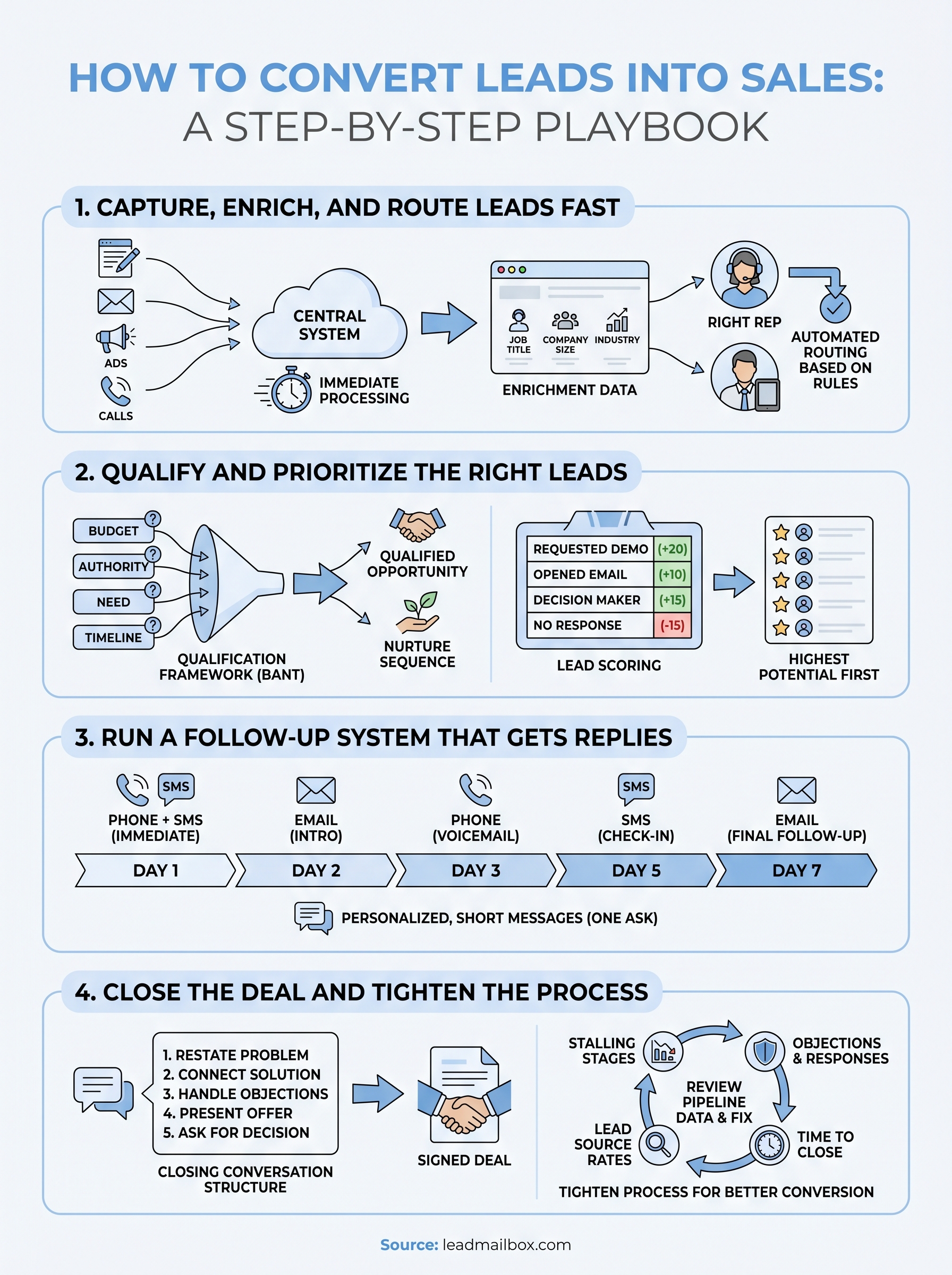
You now have a complete framework for how to convert leads into sales: capture and route fast, qualify with clear criteria, follow up across multiple channels, and close with a structured conversation backed by pipeline data. Each step builds on the one before it, so the biggest gains come from applying all four in sequence rather than picking one and ignoring the rest.
Start by identifying the weakest link in your current process. If leads sit uncontacted for hours, fix Step 1 first. If your reps have no consistent follow-up cadence, build that sequence this week before touching anything else. Small, targeted fixes compound quickly once your team runs the same playbook across every lead.
If you want a platform that handles lead aggregation, calling, SMS, email, and AI-powered outreach in one place, take a closer look at LeadMailbox and see how it fits your sales process.