

10 Lead Scoring Best Practices for Better Sales Handoffs
Not every lead deserves the same attention. Some are ready to buy, others are just browsing, and your sales team shouldn't have to guess which is which. That's where lead scoring best practices come in, they give you a structured way to rank and prioritize leads so reps spend their time on the ones most likely to close.
But a scoring model is only as good as its setup. Get the criteria wrong, assign arbitrary point values, or skip alignment between marketing and sales, and you end up with a system that creates more confusion than clarity. The goal is a clean handoff: marketing qualifies, scores, and passes leads that sales actually wants to work. Done right, it shortens your sales cycle and boosts conversion rates across the board.
At LeadMailbox, we've spent over 20 years helping sales teams manage and convert leads from multiple sources through a single platform. Scoring is a core piece of that puzzle. Below, we break down 10 practical best practices for building a lead scoring system that keeps your pipeline moving and your sales team focused on revenue, not guesswork.
1. Centralize lead intake with LeadMailbox
Lead scoring falls apart fast when your lead data lives in multiple places. If one rep pulls from a spreadsheet, another from a CRM, and another from a third-party vendor portal, you're scoring inconsistent data that produces unreliable results. The first step in any solid set of lead scoring best practices is to route every lead into a single system before you assign a single point.

What good looks like
A centralized intake system means every lead, regardless of source, lands in one place with the same fields populated. Whether a lead comes in from a paid ad, a web form, or a partner integration, your scoring model evaluates a complete, standardized record every time. With LeadMailbox, you connect leads from hundreds of partners and sources into one unified platform, which removes the data gaps that corrupt scoring accuracy and make sales handoffs unreliable.
Your scoring model is only as accurate as the lead data feeding it, so fix intake before you touch anything else.
Steps to implement
Start by auditing every channel where leads currently enter your business. List them all: paid lead vendors, organic web forms, inbound calls, live transfers, and referrals. Then connect each source to LeadMailbox using its native integrations so that all leads flow into a single pipeline automatically, without manual imports or file uploads.
Once intake is centralized, define required fields for each source. At minimum, capture name, phone number, email, and source tag, plus any qualifying data your scoring model needs to assign an accurate initial fit score.
Sample scoring rules
Use these as a baseline once your intake is clean and every lead source is connected:
| Signal | Points |
|---|---|
| Lead source: high-intent partner | +15 |
| All required fields populated | +10 |
| Missing phone number | -10 |
| Duplicate lead within 30 days | -20 |
Checks to run
Run these checks monthly to keep your intake reliable:
- Field completion rate: Are required fields being captured from every active source?
- Duplicate rate: What percentage of incoming leads share an email or phone with an existing record?
- Source attribution accuracy: Does every lead carry a correct, trackable source tag?
Keeping intake clean directly improves scoring reliability without requiring you to rebuild your scoring model from scratch.
2. Define your ICP and hard disqualifiers
Your scoring model needs a foundation before it can assign meaningful points. A core part of lead scoring best practices is defining your Ideal Customer Profile (ICP), the specific set of characteristics that define a lead worth pursuing. Without a clear ICP, your scoring criteria are guesswork, and guesswork produces unqualified leads landing in your reps' queue.
What good looks like
A well-defined ICP includes firmographic and demographic criteria such as industry, company size, geography, and budget range. It also includes hard disqualifiers, the attributes that automatically remove a lead from consideration regardless of engagement level.
Hard disqualifiers are non-negotiable filters. A lead that carries a competitor domain email or operates outside your serviceable area should score so low it never reaches a rep's queue at all.
Hard disqualifiers protect your pipeline from noise before a single rep picks up the phone.
Steps to implement
Start by reviewing your last 12 months of closed-won deals to identify patterns. Which industries converted fastest? Which company sizes closed at the highest rate? Document those findings, then identify what consistently disqualified leads. Those become your automatic exclusion rules inside your scoring model.
- List every ICP attribute with a point value
- Assign negative scores to hard disqualifiers large enough to drop leads below your handoff threshold
Sample scoring rules
| Signal | Points |
|---|---|
| Industry matches ICP | +20 |
| Company size within target range | +15 |
| Geography outside service area | -50 |
| Competitor domain email | -50 |
Checks to run
Revisit your ICP against closed-won data every six months. Markets shift, and your scoring criteria need to reflect current buyers, not assumptions you made a year ago.
- Are disqualified leads still reaching reps at high rates? Increase negative point values.
- Has a new customer segment emerged? Add it to your ICP and assign points accordingly.
3. Lock in MQL and SQL definitions and SLAs
Without clear definitions of what a marketing qualified lead (MQL) and a sales qualified lead (SQL) look like, your scoring model produces noise instead of direction. Reps argue about whether a lead is ready, and marketing passes leads that sales immediately rejects. Locking in these definitions is one of the most overlooked lead scoring best practices, and skipping it creates handoff friction that slows your entire pipeline down.
What good looks like
A clean setup means marketing and sales agree in writing on the exact score threshold that triggers an MQL, the additional criteria that elevate it to an SQL, and the time window in which reps must act after a lead is passed over. That window is your SLA, and it holds both teams accountable to the same standard.
Without SLAs, even a well-built scoring model produces slow follow-up and lost opportunities.
Steps to implement
Start by scheduling a joint session with marketing and sales leadership to document definitions together. Use your closed-won data to identify the score range where leads actually converted, then build your thresholds from real outcomes, not assumptions.
- Set a numeric MQL threshold (for example, 40+ points)
- Define an SQL as an MQL that also meets a minimum fit score and has shown recent engagement
- Set the SLA: reps must contact MQLs within 24 hours of handoff
Sample scoring rules
Use this table to translate your agreed definitions into system-level triggers that enforce the handoff process automatically.
| Signal | Points |
|---|---|
| Reaches MQL threshold | Triggers handoff alert |
| Rep contacts lead within SLA | Logged as compliant |
| Rep misses SLA window | Escalation triggered |
Checks to run
Review MQL-to-SQL conversion rates monthly and track how consistently reps meet their SLA window. If conversion drops below your target baseline, revisit threshold definitions before changing any other part of your scoring model.
4. Separate fit score from engagement score
A single composite score can hide critical information about where a lead actually stands. Combining fit and engagement into one number means a poorly fitting lead with high activity can outrank a perfect-fit lead who just hasn't acted yet. Treating them as two separate dimensions is one of the most effective lead scoring best practices for making smarter handoff decisions.

What good looks like
A clean model tracks fit score (who the lead is) and engagement score (what they've done) independently. Your reps then see both numbers at a glance, which tells them not just that a lead crossed a threshold but why it did.
A high engagement score from a low-fit lead is noise; a high-fit lead with low engagement is an opportunity worth nurturing.
Steps to implement
Build two distinct score fields in your system. Assign fit score points based on ICP attributes like industry, company size, and geography. Assign engagement score points based on actions like email opens, calls answered, and link clicks. Set your handoff trigger to require both scores to meet minimum thresholds before passing a lead to sales.
- Fit threshold example: 35+ points
- Engagement threshold example: 20+ points
- Handoff only triggers when both minimums are met
Sample scoring rules
Apply these rules across your fit and engagement fields separately to keep your scoring model clean and readable.
| Signal | Score Type | Points |
|---|---|---|
| Industry matches ICP | Fit | +20 |
| Email opened | Engagement | +5 |
| Clicked pricing link | Engagement | +15 |
| No activity in 30 days | Engagement | -10 |
Checks to run
Review both scores on converted leads each quarter to confirm your thresholds reflect actual buyer behavior. If high-fit leads consistently show low engagement at conversion, lower your engagement threshold for that segment rather than penalizing sales with cold handoffs.
5. Use explicit and behavioral signals together
Relying on only one type of signal gives you an incomplete picture of each lead. Explicit signals (what a lead tells you directly, like their job title or company size) confirm fit, while behavioral signals (what a lead does, like clicking a pricing page or answering a call) confirm intent. Combining both in your scoring model is one of the most reliable lead scoring best practices because it rewards leads who match your ICP and are actively showing interest.
What good looks like
A strong model treats explicit data and behavioral data as partners, not substitutes. When a lead matches your target industry and has also opened three emails and clicked a demo link, your scoring model captures all of that and reflects the full picture of readiness.
Explicit signals tell you who's worth calling; behavioral signals tell you when to call them.
Steps to implement
Start by listing every explicit attribute your intake form or CRM captures, then map each one to a point value based on ICP priority. Next, identify the behavioral actions your marketing tools track, such as email opens, link clicks, inbound calls, and SMS replies, and assign points based on how strongly each action correlates with a closed deal.
Sample scoring rules
| Signal | Type | Points |
|---|---|---|
| Job title matches buyer persona | Explicit | +15 |
| Opened two or more emails | Behavioral | +10 |
| Clicked demo request link | Behavioral | +20 |
| Provided accurate phone number | Explicit | +10 |
Checks to run
Review your top closed-won leads each quarter and identify which explicit and behavioral signals they shared most consistently. If a specific action like answering an inbound call regularly precedes a close, increase its point value to reflect that real-world pattern in your model.
6. Apply negative scoring to filter distractions
Most scoring models focus exclusively on adding points, which means leads that look active on the surface but carry disqualifying signals can pile up in your queue and waste your reps' time. Negative scoring removes those distractions automatically, keeping your pipeline filled with leads that are actually worth pursuing.
What good looks like
A well-built model assigns negative point values to signals that indicate low intent, poor fit, or wasted activity. When a lead's negative signals outweigh their positive ones, their score drops below your handoff threshold and they stay in nurture mode instead of reaching a rep prematurely.
Negative scoring is how you protect your sales team's time without requiring a manager to manually filter every lead.
Steps to implement
Start by reviewing leads your reps rejected or ignored over the last 90 days. Identify what those leads had in common, whether it's a specific source, a missing field, or a pattern of low-value actions like opening one email and never responding again. Then assign negative point values to each of those signals directly inside your scoring model.
Sample scoring rules
| Signal | Points |
|---|---|
| Unsubscribed from email | -30 |
| Personal email domain (Gmail, Yahoo) | -15 |
| No activity in 45 days | -20 |
| Invalid phone number | -25 |
Checks to run
Review your negative scoring rules each quarter by pulling a list of leads that dropped below your threshold. Confirm those leads would genuinely be a poor use of rep time. If valid prospects are getting filtered out incorrectly, adjust the point values rather than removing the rule entirely, since these lead scoring best practices work best when calibrated against real outcomes rather than assumptions.
7. Add time decay so scores reflect fresh intent
A lead who downloaded a guide six months ago is not the same as one who clicked your pricing page yesterday. Without time decay built into your model, old activity inflates scores and pushes stale leads into your active queue. One of the most overlooked lead scoring best practices is reducing point values automatically as leads age so your scores reflect current intent, not historical noise.
What good looks like
Your scoring model applies a percentage reduction to engagement points after a set period of inactivity. A lead who answered a call last week holds their score. A lead who went quiet for 60 days loses points progressively until they either re-engage or fall below your handoff threshold entirely.
Time decay keeps your queue filled with leads who are actually thinking about buying right now, not leads who clicked something months ago and moved on.
Steps to implement
Set decay rules based on your average sales cycle length. If your cycle runs 30 days, start decay at 14 days. For longer cycles, give leads more runway before points begin dropping.
- Engagement points decay 25% after 30 days of inactivity
- Decay another 25% at 60 days
- Drop leads below your handoff threshold at 90 days with no engagement
Sample scoring rules
| Signal | Points |
|---|---|
| No activity for 30 days | -10 |
| No activity for 60 days | -20 |
| Re-engaged after decay period | +15 |
Checks to run
Review your decay thresholds quarterly against actual re-engagement data. If leads regularly bounce back after 45 days, extend your decay window rather than losing prospects who simply take longer to decide.
8. Calibrate points using conversion data
Point values in most scoring models are set by instinct on day one and never revisited. That means your model keeps rewarding signals that no longer predict revenue and ignores ones that actually do. One of the most impactful lead scoring best practices is to replace those gut-feel numbers with point values backed by real conversion data from your own pipeline.
What good looks like
Your model treats point values as working hypotheses, not permanent settings. When you review closed-won deals and compare them to closed-lost deals, patterns emerge that tell you which signals actually drove conversion. A well-calibrated model reflects those patterns so your scoring thresholds align with how buyers actually behave, not how you assumed they would.
Point values that come from real data outperform point values that come from a conference room whiteboard every time.
Steps to implement
Pull a report of your last 90 days of closed-won and closed-lost leads and compare the scoring signals each group shared. Identify which actions or attributes appeared far more often in closed-won records and increase those point values proportionally. Reduce or remove points for signals that appeared equally in both groups, since those signals carry no predictive weight.
Sample scoring rules
| Signal | Old Points | Data-Adjusted Points |
|---|---|---|
| Email opened | +5 | +3 |
| Answered inbound call | +10 | +20 |
| Clicked pricing page | +15 | +25 |
| Submitted web form only | +10 | +5 |
Checks to run
Recalibrate your point values every quarter using fresh closed-won data. Confirm that leads who converted consistently scored above your MQL threshold before handoff, and adjust thresholds if a meaningful gap exists between where leads scored and where they actually converted.
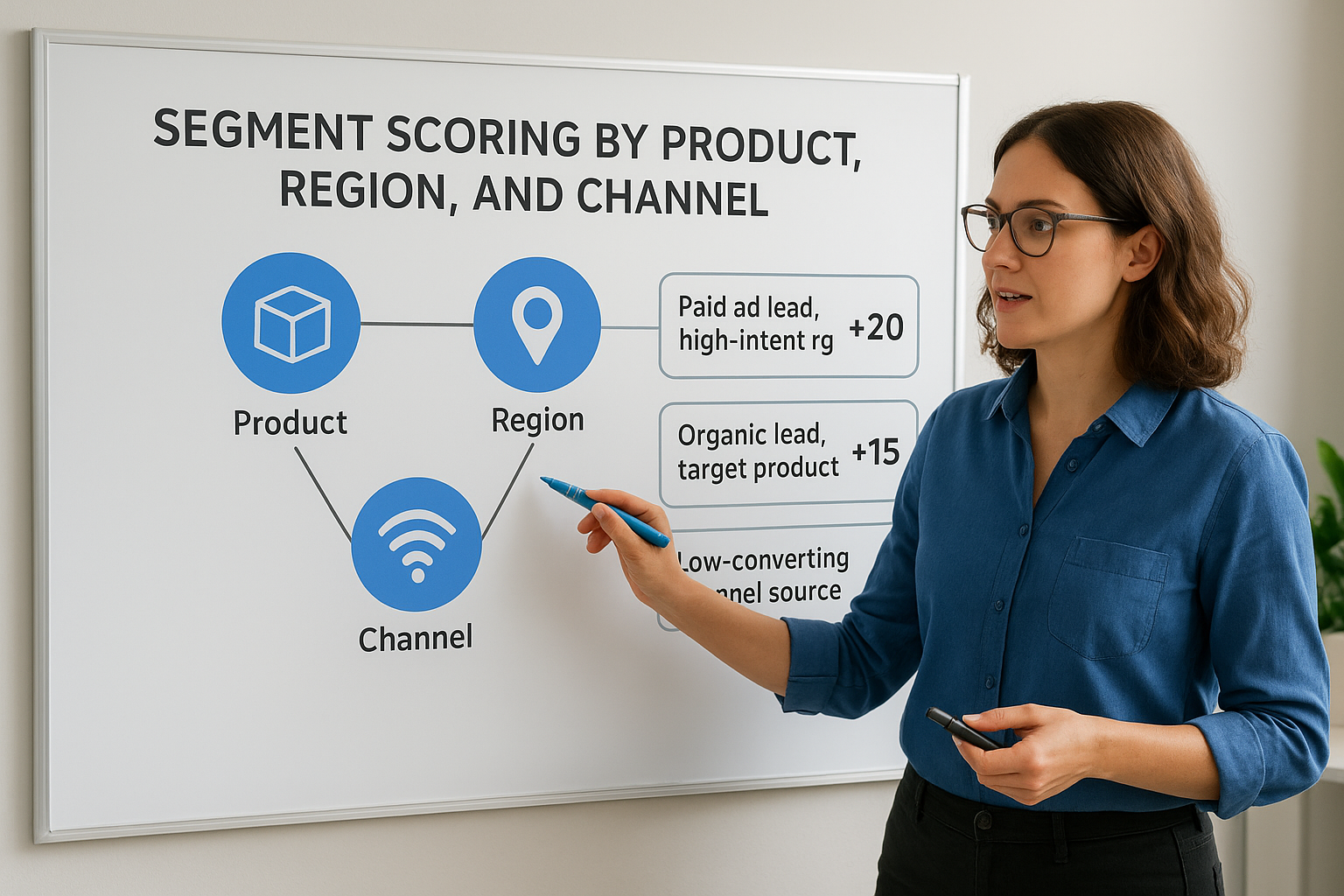
9. Segment scoring by product, region, and channel
A single scoring model applied to every lead in your pipeline ignores the real differences between buyer segments. A lead shopping for a basic plan in one region behaves differently than a lead evaluating an enterprise solution in another. Using segmented scoring is one of the sharper lead scoring best practices you can apply because it lets your model reflect how different buyers actually move through your pipeline.
What good looks like
Segmented scoring means you run separate scoring rules for each meaningful dimension of your pipeline: the product a lead is interested in, the geographic market they're in, and the channel they entered through. A lead who clicked a paid ad for Product A in the Southeast scores differently than an organic lead in the Midwest who expressed interest in Product B. Your model captures those differences instead of flattening them into one number.
One scoring model rarely fits every buyer segment equally, so build yours to reflect the differences that actually drive conversion.
Steps to implement
Start by identifying your top three to five segments across product lines, regions, and lead sources. Build separate scoring criteria for each, keeping your ICP attributes and behavioral signals consistent but adjusting point weights to match how each segment converts historically.
Sample scoring rules
| Signal | Segment | Points |
|---|---|---|
| Paid ad lead, high-intent region | Channel + Region | +20 |
| Organic lead, target product page | Channel + Product | +15 |
| Low-converting channel source | Channel | -10 |
Checks to run
Review segment-level conversion rates quarterly to confirm your scoring weights still reflect current performance. If one region or channel starts converting faster, increase its point values to match the new pattern.
10. Keep your model clean with a scoring audit
Scoring models drift over time. Criteria that made sense when you built the model stop reflecting how your current buyers behave, and nobody notices until reps start complaining that the leads coming through aren't closing. Running a regular scoring audit is one of the final but most important lead scoring best practices because it keeps every other element of your model working the way you intended.
What good looks like
A clean model means your point values, thresholds, and scoring rules still match your conversion data. You aren't carrying criteria you built two years ago that no longer predict anything. Your team reviews the model on a set schedule, not just when something breaks.
A scoring model you never audit is a model that quietly stops working while you assume it still is.
Steps to implement
Schedule a quarterly audit that covers three areas: scoring criteria accuracy, threshold alignment, and field data quality. Pull closed-won and closed-lost data from the most recent quarter, compare which signals those leads carried, and confirm your point values still reflect the patterns you see. Update any rule that no longer matches the data.
Sample scoring rules
| Audit Finding | Corrective Action |
|---|---|
| High-point signal rarely appears in closed-won | Reduce point value |
| Low-point signal common in closed-won | Increase point value |
| Threshold too low, volume unmanageable | Raise MQL threshold by 10 points |
Checks to run
After each audit, document every change you make and the data that drove the decision. Confirm your MQL-to-SQL conversion rate improved or held steady within 60 days of any update, and flag any scoring rule that hasn't been reviewed in over six months for immediate evaluation.
What to do next
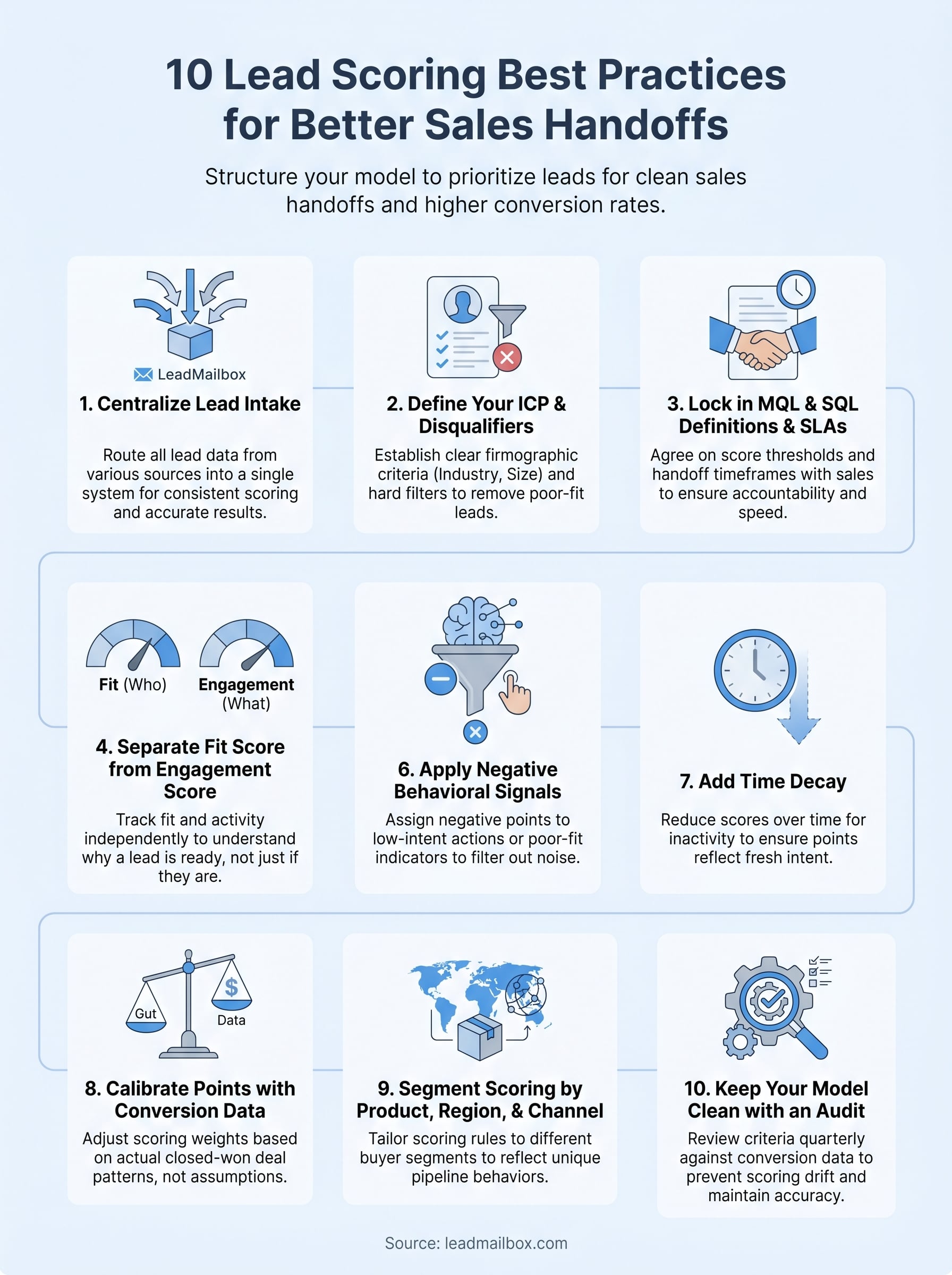
The lead scoring best practices in this guide give you a complete framework, but they only produce results if you actually build and maintain the model. Start with the foundation: centralize your lead intake, lock in your ICP, and define MQL and SQL thresholds with your sales team before you touch a single point value.
From there, layer in fit and engagement scoring, add negative scoring and time decay, and calibrate your point values against real conversion data. Each step builds on the last, so rushing past the early setup stages will make every step after it less accurate.
You don't need to overhaul everything at once. Pick the two or three practices that address your biggest current problem, whether that's slow handoffs, unqualified leads reaching reps, or stale data inflating scores, and start there. When you're ready to put this into practice with a platform built to support it, explore LeadMailbox and see how it fits your pipeline.