

Predictive Dialer Vs Power Dialer: Which One Fits Your Team?
Choosing between a predictive dialer vs power dialer comes down to one question: does your team need raw call volume, or does it need control over every conversation? Both tools automate outbound dialing, but they do it in fundamentally different ways, and picking the wrong one can hurt your connect rates, frustrate your agents, or waste money on features you don't need.
Predictive dialers use algorithms to dial multiple numbers simultaneously, routing answered calls to available agents. Power dialers take a more measured approach, dialing one contact at a time so your reps can review lead details and prepare before each call. The right choice depends on your team size, your sales process, and how much personalization matters in your outreach.
At LeadMailbox, we've built our telephony suite, including a power dialer, click-to-call, and insta-call, around the idea that sales teams need flexibility, not a one-size-fits-all tool. This guide breaks down exactly how predictive and power dialers differ, where each one shines, and how to match the right dialer to the way your team actually sells.
Why dialer choice affects pipeline and compliance
Your dialer isn't just a calling tool. It's the engine that determines how many contacts your team reaches each day, how prepared your reps feel before each conversation, and whether your outreach process holds up under regulatory pressure. A poor fit between your dialer and your sales motion creates bottlenecks you might not notice until your numbers start slipping and pipeline stalls.
How dialers shape your sales pipeline
The dialer you pick directly controls the pace and quality of conversations your team can have. A team running high call volume with a tool that forces agents to slow down will miss leads before competitors reach them. On the flip side, a team doing consultative selling with a tool that moves too fast will have reps jumping into calls unprepared, which damages conversion rates and erodes trust with prospects.
When you're weighing the predictive dialer vs power dialer question, think about where deals actually die in your pipeline. If your team struggles to reach enough prospects, speed is the bottleneck. If your reps reach plenty of people but can't convert them, preparation and context are the real problem. The dialer you choose either solves or worsens whichever issue you already have, so getting it right matters more than most teams realize.
The dialer you use doesn't just affect call volume - it shapes every rep's ability to deliver a quality conversation at scale.
Compliance risk is real and costly
Outbound calling in the United States operates under strict federal regulations, primarily the Telephone Consumer Protection Act (TCPA) and rules enforced by the Federal Communications Commission. These rules govern how many times you can call someone, what hours you can dial, and in some circumstances, whether you need prior written consent before using an automated dialer at all.
Predictive dialers, because they dial multiple numbers simultaneously and sometimes abandon calls when no agent is available, carry higher compliance exposure than power dialers. The FCC limits the percentage of abandoned calls an organization can generate to no more than three percent of all calls answered by a live person in a 30-day period. Violations are not theoretical - they carry penalties up to $1,500 per call under TCPA in certain circumstances.
Power dialers reduce that exposure because each call connects directly to an agent the moment a contact picks up. That structure makes it easier to document consent, maintain accurate call logs, and avoid the abandoned call problem entirely. For businesses in regulated industries like insurance, finance, or healthcare, that structural difference can be the deciding factor between clean compliance and a significant fine.
What a power dialer is and how it works
A power dialer is an outbound calling tool that dials one contact at a time and connects the call to an available agent the moment someone picks up. Unlike a predictive dialer, which fires off multiple simultaneous calls using algorithms, a power dialer moves through your contact list at a pace you control, giving your reps a consistent, structured workflow without call overlap or abandoned connections.
How the dialing sequence works
When a rep finishes a call, the power dialer automatically moves to the next number in the queue without requiring manual input. This removes dead time between calls while keeping the agent in full control before the conversation starts. Your reps can see the lead's information on screen before the call connects, so they're not jumping in blind every time a new contact picks up.

A power dialer gives your reps the speed of automation without sacrificing the moment of preparation that separates a useful call from a wasted one.
Your team can also set the dialer to skip certain numbers, flag contacts for follow-up, or log call outcomes directly in the system. That kind of structured feedback loop keeps your pipeline data clean and your follow-up process consistent across the whole team.
What power dialers handle automatically
Power dialers take over several repetitive tasks that slow reps down. They detect voicemails and busy signals, skip disconnected numbers, and can drop a pre-recorded voicemail message without the agent waiting through the tone. When you evaluate the predictive dialer vs power dialer decision, this is where the power dialer earns its value for smaller teams: it removes manual friction while keeping every live conversation intentional and one-to-one.
What a predictive dialer is and how it works
A predictive dialer is an outbound calling system that dials multiple numbers simultaneously and uses an algorithm to predict when your agents will finish their current calls. When a contact answers, the system immediately routes that call to the next available rep. The goal is to minimize idle time between calls and push your team's call volume as high as possible across a shift.
How the algorithm manages call pacing
The algorithm at the core of a predictive dialer monitors several variables in real time: average call duration, agent availability, and the ratio of answered calls to voicemails or no-answers. Based on those inputs, it decides how many lines to dial simultaneously at any given moment. If your team has ten agents and the system expects most contacts won't answer, it might dial twenty or thirty numbers at once to keep agents active.

Because the algorithm controls pacing automatically, your reps have almost no time to review lead details before a call connects. Speed is the entire point, and the system is optimized around that priority rather than the quality of any individual conversation.
What happens when too many calls connect at once
When the algorithm misjudges timing and more contacts answer than agents are available, those extra calls get abandoned. The system either plays a pre-recorded message or simply drops the connection. That abandoned call problem is exactly why predictive dialers carry higher compliance risk, and why federal regulators track abandonment rates so closely.
This structural tradeoff sits at the center of the predictive dialer vs power dialer decision: raw throughput versus the control that keeps every answered call in a rep's hands.
Understanding this dynamic helps you see the predictive dialer for what it is: a tool built for maximum call volume at the cost of pre-call preparation and tighter regulatory exposure.
Predictive dialer vs power dialer: key differences
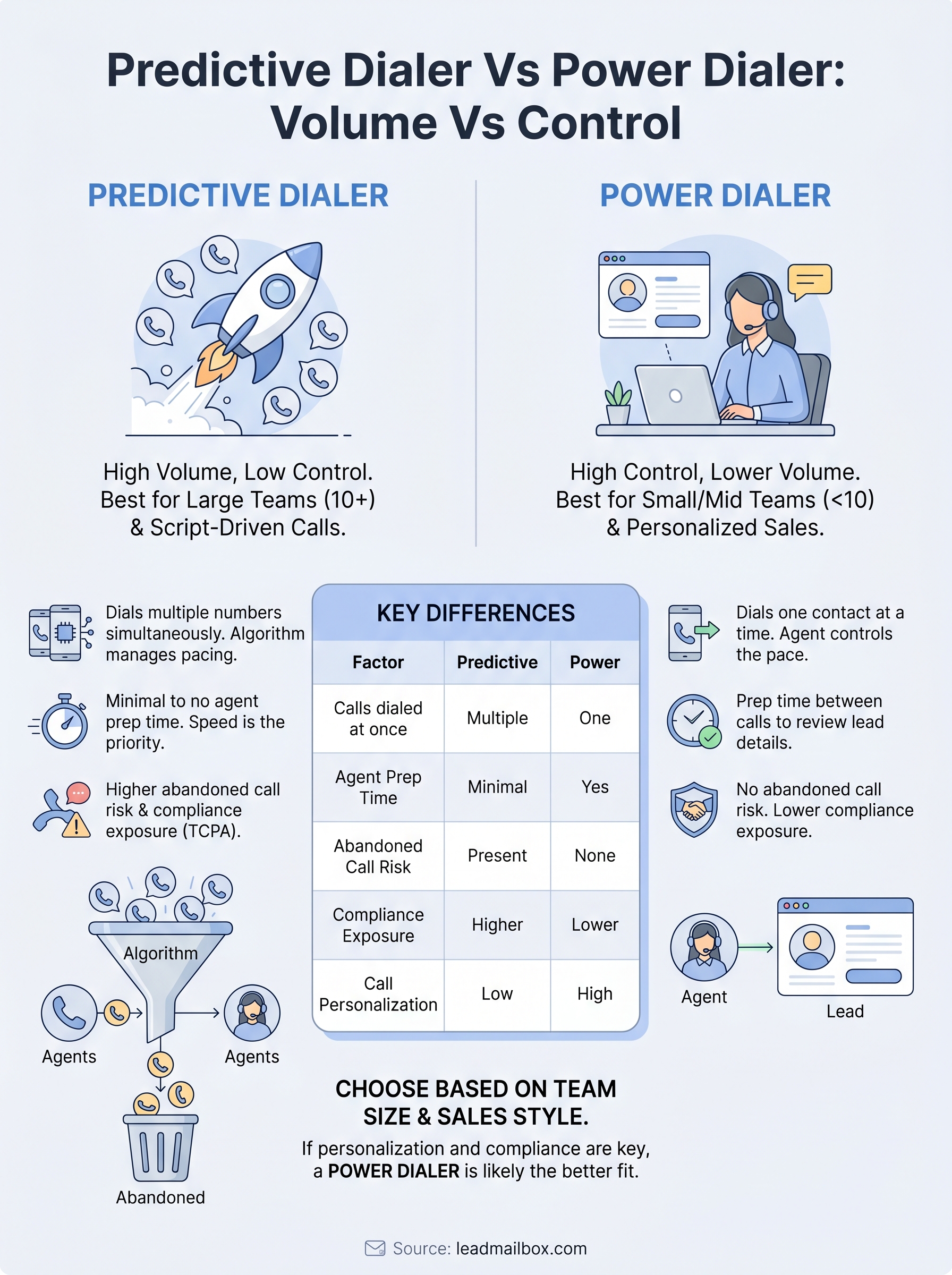
When you look at these two tools side by side, the core distinction is control versus volume. A power dialer gives your rep ownership of every call, while a predictive dialer hands that control over to an algorithm in exchange for throughput. Both tools automate dialing, but they prioritize completely different outcomes for your sales team.
Where the tools diverge most sharply
The table below puts the key differences in plain view so you can quickly identify which system matches your team's actual workflow.
| Factor | Power Dialer | Predictive Dialer |
|---|---|---|
| Calls dialed at once | One at a time | Multiple simultaneously |
| Agent prep time | Yes, between calls | Minimal to none |
| Abandoned call risk | None | Present |
| Best team size | Small to mid-size | Large (10+ agents) |
| Compliance exposure | Lower | Higher |
| Call personalization | High | Low |
The predictive dialer vs power dialer decision often comes down to this: if your reps need to know who they are talking to before the call connects, a power dialer fits your process better.
How team size and sales style shape the fit
Larger teams with 10 or more agents can absorb the variability that predictive dialers introduce, because the algorithm needs enough agents available to route answered calls without generating abandoned connections. Smaller teams running that same tool will produce more abandoned calls, which damages compliance ratios and burns leads before a rep ever speaks to them.
Your sales style matters just as much as headcount. If your reps work from scripts and handle high volumes of short conversations, predictive dialing aligns with that motion. If your team leads with personalized outreach and relies on context from lead data before each conversation, the power dialer keeps that preparation intact without sacrificing your overall call pace.
How to choose the right dialer for your team
Picking the right dialer starts with an honest look at how your team operates today, not how you hope it will operate after you add a new tool. Most teams already have a defined sales motion, a target contact volume, and a clear sense of how much each lead costs them. Those three factors point directly toward one dialer type or the other before you even evaluate specific features.
Consider your team size first
If your team has fewer than ten agents, a power dialer fits your structure better. Predictive dialers need enough agents available at any given moment to absorb the answered calls the algorithm routes their way. With a small team, the algorithm generates too many abandoned calls, which burns leads and pushes your compliance metrics in the wrong direction.
Teams with ten or more agents running high-volume outreach can take advantage of what predictive dialers are built for. The algorithm works well at scale because there are always enough reps available to handle incoming connections without leaving contacts waiting or dropping calls.
Match the dialer to your sales process
This is where the predictive dialer vs power dialer question gets settled for most teams. If your reps rely on lead data, context from prior interactions, or any kind of customized opening, a power dialer preserves that preparation window without slowing your overall call rate. Reps who go in cold convert at lower rates, and no amount of call volume makes up for that gap.
If personalization drives your close rate, build your dialing workflow around a tool that protects it.
For teams running script-driven calls with short average handle times and that prioritize reach over relationship, a predictive dialer delivers the throughput your model needs.
Your next step
The predictive dialer vs power dialer decision doesn't have to be complicated. If your team runs high-volume, script-driven outreach with ten or more agents, a predictive dialer gives you the throughput to match. If your reps need preparation time, work with smaller contact lists, or operate in a regulated industry, a power dialer fits your process without the compliance exposure.
Most small to mid-sized sales teams land firmly in the power dialer camp, and that's exactly what LeadMailbox built its telephony suite around. The platform gives you a power dialer, click-to-call, insta-call, and inbound number management in one place, so your team isn't stitching together separate tools to run a basic outbound workflow.
If you want to see how it works for your team, explore LeadMailbox's lead management and dialing tools and find the setup that fits your actual sales process.